

Drug discovery used to be a linear, trial-and-error-based process. Now it is precision engineering. That means better clinical candidates are generated, faster. Human trials remain a development mainstay, but streamlined site selection, protocol design and recruitment – plus optimized molecules – may boost speed and success rates in the clinic too.
This matters, because the old R&D model has long become unsustainable. Pricing pressure, competition and an ever-higher efficacy bar demand cheaper, faster drug making.
The shift is not just down to AI. It comes thanks to a suite of technologies – such as single cell RNA sequencing, spatial transcriptomics, proteomic analyses and population genetics – that have also progressed significantly over the last five years. These advances are converging with newly powerful large language models (LLMs) in what GlaxoSmithKline’s R&D head Tony Wood calls a “convenient intersection”.
The result is more precise ways to measure disease, a better understanding of causal mechanisms, and more accurate linking of clinical phenotypes with underlying biology. “We now know what we control and how we control it,” says Peter Ulrichts, chief scientific officer at Argenx. Already, “we can feel the difference in speed”, says GSK’s Wood, claiming two-year idea-to-candidate timelines, on par with the best of the Chinese.
Evidence of this acceleration has yet to appear in the data. Until recently, R&D timelines and costs have continued to rise, according to Evaluate’s latest analysis.
Pharma R&D spend growth is set to slow during the early part of next decade, as signalled in the last two World Previews. But it is unclear – for now – whether this slower spend growth means greater efficacy, since pipelines at the top 25 biopharma firms are also shrinking.
Worldwide Pharma R&D Spend
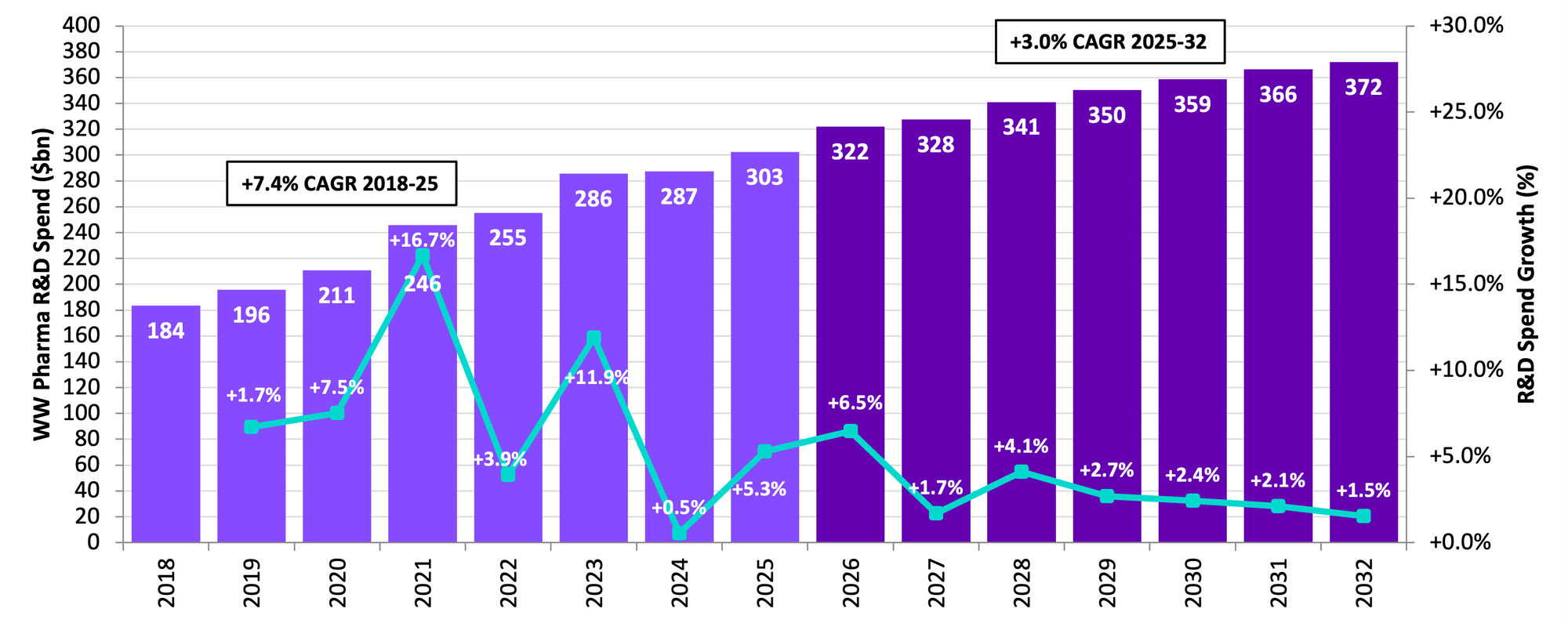
Source: Evaluate World Preview report, 2026
So, paradoxically, might faster R&D lead to fewer drugs? Tougher commercial markets demand greater R&D discipline. Already, late-stage failure rates appear to be dropping as pharma firms set higher hurdles for compounds to progress into development and kill more projects earlier.
Later-stage pipelines still need to be filled, though – more urgently given a swell of patent expiries. Hence the flurry of deals to access relatively low-risk “best-in-class” candidates, differentiated mostly by convenience or tolerability.
Johnson & Johnson’s EVP, Innovative Medicine, R&D John Reed says his company is only interested in first-in-class or “truly differentiated” molecules. Argenx’s Ulrichts also dismisses incremental benefit in favor of novel biology.
But what counts as “true” differentiation or innovation is shifting, too. J&J’s newly approved psoriasis drug Icotyde (icotrokinra), for instance, targets the same IL-23 pathway as injectable Tremfya but is taken as a once-daily pill. It’s a first oral peptide biologic, but not the first IL-23-targeted drug. Argenx’s Vyvgart Hytrulo is a more convenient, self-administrable version of the infused original.
For GSK’s Wood, very best-in-class molecules, optimized for efficacy, safety, convenience and adherence, represent “terminal innovation”. Such assets have driven much of GSK’s recent dealmaking, and that of most other Big Pharma, too. They also shape biotech financing as a result.
While best-in-class dominates much of industry’s later-stage pipeline, it’s a different story upstream. Tools and techs are helping uncover new targets, mechanisms and modalities to underpin the next wave of medical breakthroughs. Wood sees most promise in oligonucleotide-based drugs and other modalities offering programmatic intervention in disease processes.
Until then, there’s a bifurcation between “delivering the now, and setting up the tomorrow,” he says.
Our upcoming report series will explore what ‘now’ and ‘tomorrow’ look like for GSK, J&J’s obsession with focus and development cycle times, and how biopharma R&D leaders are adapting their organisations to an era of greater competition, speed and discipline. Do nimble biotechs have an even greater advantage over Big Pharma, as the tech revolution forces almost continuous process re-design?
